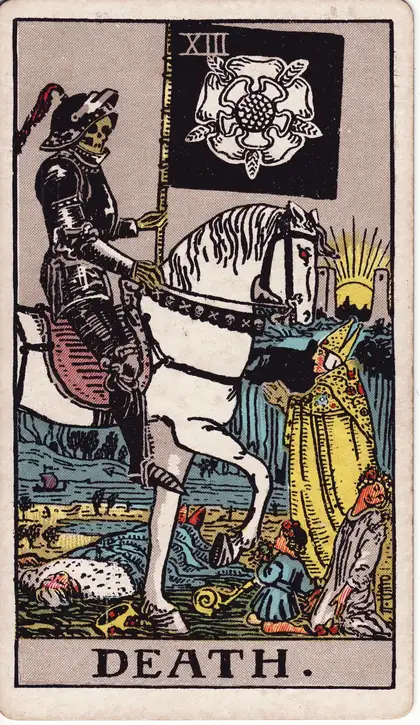
Card images: Pamela Colman Smith, 1909/1910, gemeinfrei
Death
Card of transformation · Major Arcana XIII
Hardly any card is misunderstood as often as the thirteenth. In Tarot, Death stands not for a physical end but for transformation: something old may go so that something new finds room. The image shows a rider in the morning light – and in the background the sun is already rising.
Image & Symbolism
A skeleton in black armour rides a white horse through a flat landscape. It carries a black banner with a white rose of five petals – an old symbol of purity and of life that renews itself again and again. Before the rider appear people of different rank: a king lies on the ground, his crown has slipped from him. A cleric stands with folded hands, a young girl turns away, a child looks the rider openly in the face. This scene tells that change reaches everyone, whatever their rank, and that there are different ways of meeting it: holding on, pleading, evading or childlike openness. In the background a river flows with a boat drifting on it, and between two towers a golden sun rises. This detail is the key to the card: every ending carries a beginning within it. In the Golden Dawn attribution the card belongs to Scorpio, the water sign of depth, passion and renewal. Scorpio gets to the bottom of things and shies away from no intensity. This gives the image a psychological colouring: it is about inner sheddings, about laying down roles, attitudes and habits that have become too tight.
As a birth card
Death as a birth card describes a person who not only endures transformation but understands it. The thirteen is your personality card; the digit sum four leads to the Emperor as soul card. Outwardly you show the ability to make clean cuts and to say goodbye to the outdated; inwardly the Emperor gives you structure, reliability and the wish to build the new on a stable footing. In everyday life you are often the person who, in deadlocked situations, says: this cannot go on. You recognise when something has served its purpose. Professionally, tasks involving upheaval and new beginnings suit you: accompanying change processes, reorganising workflows, turning crises into opportunities, guiding people through transitions. In relationships your depth and honesty are valued. Superficiality bores you; you seek connections that are allowed to develop along with you. You may recognise yourself in the fact that new beginnings, whether through moves, career changes or new ways of living, are for you part of the path rather than the exception. From this a composure can grow: the trust that after an ending, something begins again.
As a year card
As the theme of a year this card puts letting go at the centre – a theme that sounds serious at first and yet can hold a lot of relief. What have you already finished inwardly without admitting it to yourself? Are there roles, plans or habits that cost you more strength than they give back? The card suggests examining such questions calmly rather than forcing changes. Sometimes it is enough to clear out a cupboard, hand over a commitment or shape a farewell consciously. The rising sun in the picture reminds you that room for the new usually arises where something old was allowed to go with dignity. It can help to mark endings deliberately – with a letter you do not send, a conversation or a small personal ritual. That way the new gets not only room but also a clear starting point.
Light & Shadow
The strength of the thirteenth card is courage for transformation. Whoever is shaped by it can let go without turning bitter, and begin again without denying the past. These people are often a support for others when circumstances change fundamentally. The flip side shows in two directions. Either the old is held on to for too long, like the king who will not give up his crown. Or things are cut off too quickly, out of fear of closeness or of the pain of parting. Here you can grow by giving transitions time: grief, gratitude and anticipation may exist side by side. The child on the card shows a beautiful attitude for this: it faces change openly without knowing what it brings. This curiosity can be practised, step by step and without pressure.
Frequently asked questions
Does the Death card mean something terrible?
No, quite the opposite. In Tarot the Death card describes no physical farewell but a phase of transformation. The image shows that something may come to an end so that something new can grow – visible in the rising sun in the background. Many card readers even see in it a liberating card that allows you to let go of the outdated and walk on with lighter luggage.
What does Death mean as a birth card?
Death as a birth card stands for depth, honesty and a special ability to shape change. You recognise when something is over and can make clear decisions. Your soul card is the Emperor: he makes sure that every ending is followed by a stable, well-considered new beginning. So courage for change and a sense of permanence come together.
Why does the Death card belong to Scorpio?
In astrology Scorpio counts as the sign of intensity, passion and renewal. It seeks the essential and shies away from no difficult subject. These qualities suit the thirteenth card: it too goes beneath the surface and demands that things be looked at honestly. The water sign here stands for the emotional side of change.
How are Death and the Emperor connected?
In the birth card calculation the thirteen reduces to four. Whoever has the thirteenth card as a personality card carries the Emperor as soul card. The two complement each other well: one card clears out and makes room, the other builds up and gives order. Together they describe a person who joins change with responsibility.