Card images: Pamela Colman Smith, 1909/1910, gemeinfrei
The Hierophant
Teacher, tradition and shared values · Card V
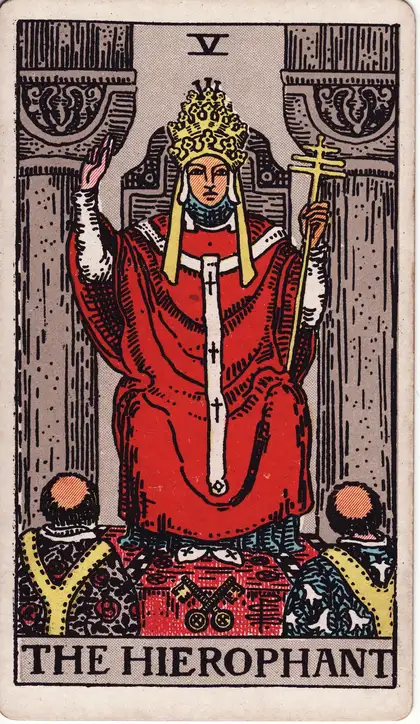
The Hierophant is enthroned between two grey pillars and blesses two figures kneeling before him. He is the mediator: between knowledge and learners, between inherited values and the individual. The fifth card stands for teaching, rituals, belonging and the question of what you orient your life by.
Image & Symbolism
At first glance the card recalls a church scene. A dignitary in a red robe sits on a raised seat, on his head a three-tiered crown. The three levels can be read as body, mind and soul, or as three stages of learning. The right hand is raised in blessing, two fingers pointing up, two bent – a hint at visible and hidden knowledge. In the left he holds a staff with three crossbars. At his feet lie two crossed keys, gold and silver, often read as access to outer and inner understanding. Before him kneel two people in robes embroidered with roses and lilies; they receive what is being passed on. The Hierophant is thus the counterpart of the High Priestess: where she guards secrets, he makes knowledge teachable and shares it within a community. According to the Golden Dawn teaching the card belongs to Taurus, an earth sign of Venus. That fits the figure's steadiness: values should carry, rituals should be repeated until they give support. The five stands between the order of the four and the choice of the six, and brings the question of meaning into play.
As a birth card
As a soul card the Hierophant lies behind Temperance (14). If the five stands in your birth date without a preceding card, it describes both your effect on others and your inner drive. That drive has to do with meaning and passing things on. You want to understand why things are the way they are, and to share that understanding with others. Many people with this card are born explainers and mentors. In everyday life rituals give you support: the fixed morning coffee, the family meal on Sunday, a club, a choir, a community with shared values. Professionally you are strong where knowledge is conveyed in a structured way – school, training, counselling, pastoral care, quality assurance. In relationships, commitment and shared core values matter to you. The Taurus influence makes you patient and faithful, sometimes a little deliberate when it comes to change. Others like to come to you with questions because you prepare knowledge patiently and comprehensibly. What matters for you is that teaching does not become a one-way street: you too learn most in conversation.
As a year card
Under the Hierophant, a year becomes an opportunity to sort out your values. Which convictions have you adopted without ever examining them? Which do you carry with your whole heart? The question of teachers comes up here too: from whom would you like to learn, and to whom could you pass something on yourself? A year like this can feel right for further training, a mentorship or the deliberate tending of rituals that do you good. It is just as legitimate to say goodbye to a tradition that no longer suits you. The core of the theme is belonging by free choice: you may choose which community and which rules you commit to. A simple way in: note three principles you live by, and ask yourself where each of them comes from.
Light & Shadow
At his best the Hierophant is a wise teacher who gives orientation without patronising. He preserves knowledge that has proved itself over generations and creates community through shared rituals. When the card tips, tradition becomes dogma. Then the rule counts more than the person, and questions are treated as a disturbance. The shadow can also show in your own inner life: as conformity at any price, as fear of falling out of a group, or as the habit of trusting authorities blindly. The way forward is shown by the question of what you do out of inner conviction and what only because that is how it is done. A living tradition can bear questions; indeed it needs them. You can value rituals and still develop them further instead of preserving them unchanged. That is the mature expression of this card.
Frequently asked questions
Is the Hierophant the same as the Pope?
In older decks the fifth card is indeed called the Pope. The term Hierophant comes from ancient Greece and denoted the priest who initiated people into sacred mysteries. The renaming opens the card up beyond a particular church: what is meant is every form of teaching, tradition and shared belief. So it also suits people without religious ties.
What role does the Hierophant play behind Temperance?
Temperance carries the number 14, whose digit sum is five. Whoever has Temperance as a personality card comes across as balancing and mediating. Beneath lies the Hierophant as soul card, with the need for meaning and shared values. The balance visible on the outside is thus fed by a deep inner conviction. Your equilibrium, then, has a foundation.
What do the crossed keys symbolise?
The two keys at the Hierophant's feet stand for access to knowledge. They are often read as the keys to heaven and earth, or as conscious and unconscious understanding. That they lie crossed shows the connection of both realms. The Hierophant does not hold on to them; they lie ready for those who want to learn. Knowledge is offered, not imposed.