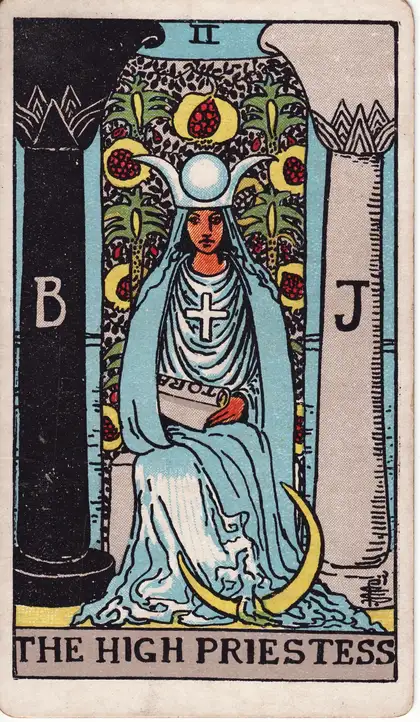
Card images: Pamela Colman Smith, 1909/1910, gemeinfrei
The High Priestess
Keeper of inner knowledge · Second card of the Major Arcana
Between a black and a white pillar sits a calm female figure, a half-covered scroll in her lap. The High Priestess embodies the knowledge that does not become loud: intuition, patience and the ability to listen before judging. Where the Magician acts, this card perceives.
Image & Symbolism
Two pillars bound the space, a dark one with the letter B and a light one with the letter J. Both recall the temple pillars Boaz and Jachin and stand for the poles between which every experience moves: night and day, receiving and giving, hidden and revealed. The Priestess sits exactly between them, not on either side. Behind her hangs a veil embroidered with palms and pomegranates – images of fertility and of an abundance that only shows itself behind the surface. Through the gaps in the fabric you sense water, but you cannot quite see it. On her lap lies a scroll whose inscription is only partly legible: this is about knowledge you do not acquire in passing. At her feet rests a crescent moon; on her head she wears a crown of waxing and waning moon. The blue robe flows to the ground like water. The Golden Dawn tradition assigns the card to the Moon, the body of tides, moods and the unconscious. This gives the figure a rhythmic quality: insight comes and goes in phases, and some things may ripen before they show themselves. The two points to polarity and to the encounter with a counterpart.
As a birth card
As a soul card the High Priestess stands behind Justice (11) and Judgement (20). If your birth date comes directly to two, this one card carries both roles, your outward manner as well as your inner core. In any case it describes a person who perceives more than they say. You notice early when something in a room is not right, and you have a fine sense for undertones. In everyday life you need phases of withdrawal to sort through impressions; afterwards you are often astonishingly clear. Professionally, activities in which listening, research or careful observation count suit you – counselling, research, archives, editing, accompanying people. In friendships and partnerships you are a reliable confidante, told things that nobody else hears. Your strength is discretion. What matters is that you give your own inner voice as much weight as the secrets of others. Allow yourself places of quiet where you do not have to achieve anything: a walk by the water, a notebook, an hour without a screen. There, what you take in during the day sorts itself out.
As a year card
A year under the High Priestess has a quieter tone. It asks questions inwards rather than outwards: what have you actually known for a long time without admitting it to yourself? Where have you overridden your gut feeling because it did not seem justifiable? It can help to write down dreams, ideas and moods and to reread them after a few weeks – patterns often only become visible in hindsight. The Moon as attribution reminds you that alertness and tiredness also run in phases. Not every decision has to be made at once; some gain when you let them rest for a while. The theme of this year is trust in your own perception, paired with the courage to eventually say out loud what you have sensed. If you like, you can set aside fixed times of quiet for it, such as one evening a week without appointments.
Light & Shadow
The bright side of this card is a deep, quiet wisdom. Whoever lives it can bear tensions without taking sides prematurely, and creates spaces in which others open up. It becomes problematic when silence turns into a shield. Then the High Priestess withdraws so far behind her veil that nobody can reach her any more, or she guards knowledge instead of sharing it. A further temptation is passivity: you sense what should be done and wait anyway. The rewarding exercise is to translate intuition into words and now and then make the invisible visible, without talking it to death. A trusted person to whom you can tell first, still unfinished hunches helps. That way the inner knowledge stays alive and loses its aloofness.
Frequently asked questions
What do the two pillars on the High Priestess card stand for?
The pillars with the letters B and J refer to Solomon's temple. In Tarot they symbolise opposites such as dark and light, or taking in and radiating out. The High Priestess sits between them and shows that wisdom does not lie in one of the poles but in the ability to hold both. Similar pillars, though without letters, also appear on the Hierophant.
Which cards have the High Priestess as their soul card?
The two lies behind two personality cards: Justice (11) and Judgement (20). Whoever carries Justice in front joins clarity and fairness with a hidden, intuitive core. With Judgement, a call for renewal meets the Priestess's quiet certainty. Both combinations join a distinct outward manner with a soft inner compass.
Is the High Priestess a card for women?
No. The female figure stands for a quality, not for a gender. Receptivity, intuition and the capacity to wait belong to every person. As a birth card the High Priestess applies to men just as much as to women and everyone else; it simply emphasises an inward-facing way of understanding the world. People who usually act rather than listen in particular can learn from her.
What distinguishes the High Priestess from the Empress?
Both cards show female figures, but their focus differs. The High Priestess is turned inwards and guards a knowledge that only slowly opens up. The Empress turns outwards, to nature, to pleasure and to the growth of visible things. One gathers, the other lets things flourish – together they form an image of depth and abundance.